When a person passes away, the hope is that their final wishes, as expressed in their Last Will & Testament, are carried out. Sometimes, however, things are not that simple.
Will contests and inheritance disputes can arise when the decedent’s testamentary capacity is unclear, raising questions about whether they were mentally capable of expressing their wishes in their Will. Other times, there are claims of duress or undue influence surrounding the preparation or revision of the Will. Families are left with unanswered questions, and at stake may be ownership interests in real estate, the family homestead, a business, cash, or even stock.
Each case is unique, fact-intensive, and often emotionally charged, and therefore best handled by skilled and compassionate litigators with experience in these particular types of disputes. Kelly Curnutt, Doug Hafer, and Hunter Rogers are equipped to champion these causes and guide clients through the difficult process of a Will contest or inheritance dispute. Our team stands committed to walk alongside our clients, armed with professionalism, integrity, and care.
Every business has a life cycle. Business owners spend years brainstorming, planning, adapting, and working tirelessly to grow their companies into thriving enterprises. Eventually, most businesses reach a point at which ownership must transition. This may take the form of an outright sale to an unrelated third party, an alliance with a strategic partner, a transfer to family members, or any number of other creative structures.
We have seen certain legal issues arise when businesses are in transition. Among the most common are:
How and when will the business owner be compensated?
Will the owner remain personally liable for any company liabilities?
May the owner distribute the company’s cash or other similar assets before or as part of the transition?
What role, if any, will the business owner have following the transition?
Will the business owner be restricted from engaging in certain activities after the transition?
These issues, along with many others, must be carefully negotiated and addressed in the transaction documents. Careful planning and document drafting by a skilled professional helps avoid confusion and potential costly liability down the road. Our experienced business team stands ready to help, whether your transaction is simple or complex.
Would you know how to handle a condemnation action involving your home, business, or land?
Condemnation is the process where certain governmental or utility entities take private property for public use, such as for major power or gas lines, utilities, road construction, drainage projects, or redevelopment. The government or other authorized entity exercises its power of eminent domain, and the owner is entitled to recover guaranteed “just compensation” for the property that is taken, whether or not the owner wants to sell. If a governmental entity has approached you about acquiring your property—commercial, residential, or unimproved land—we can help you navigate this. Know your rights before moving forward or signing anything.
With vast knowledge and experience, our team stands ready to help. Since there may be time‑sensitive deadlines, do not hesitate to contact us with any questions.
You’ve decided to buy property, sell a business, acquire services, or enter into any number of other transactions. Now what? Here are some tips from Curnutt & Hafer business and real estate attorneys, Paul Johnson and Cheyenne Haddad.
A contract is a legally enforceable agreement. Generally, whatever you promise to do in a contract, the law will require that you do it. There are exceptions to this general rule, but you should never enter into an agreement expecting to avoid the enforcement of any of its provisions. Often there will be substantial liability if you do not do what you agree to do.
2. The law imposes a duty to read contracts. If you sign a contract, you are assumed to know what is in it and to have agreed to it. Not reading a contract is no defense to its enforcement. While there can be defenses to enforcement available to those who sign a contract under unfair pressure (such as defenses based on adhesion, fraudulent inducement, and the like), such defenses are rarely successful and the burden on the person seeking these defenses is heavy.
3. Contracts do not have to be in writing: Generally, an oral contract is just as enforceable as a written contract. There are, however, some oral contracts that are not enforceable under a rule of evidence commonly called “the Statute of Frauds.” Such unenforceable oral contracts include contracts for the sale of real estate, leases of real estate for a term longer than one year, agreements that cannot be performed within one year, among others. However, be warned. Just as you should not plan to sign a contract and then avoid it later, you should not orally agree to something planning to avoid it later.
4. A contract must contain a mutual exchange. This means both parties must make some type of promise or give something of value in the contract. This is called “consideration” and is the primary reason why a mere gratuitous promise is generally not enforceable.
Be aware, however, that when the person to whom a mere gratuitous promise is made then changes their position in reliance on that promise, under the principle of “promissory estoppel,” even that gratuitous promise may become enforceable.
5. A contract does not have to be all in one document. Sometimes, multiple letters, emails, notes, and other writings can be combined to form a binding contract, even when the parties intend to cover the transaction in a more comprehensive single document later. Be careful what you write.
6. Beware of Indemnity Obligations. The party drafting the contract generally is trying to protect its own interests and not the other party’s interests. Frequently, in drafting the contract a party will provide for the other party to indemnify and defend the drafting party with respect to potential claims and other risks. Simply stated, the obligation to indemnify is an obligation to pay the other party’s losses and damages from the potential claims and risks and the obligation to defend is the obligation to provide legal defense against such matters. Indemnity provisions should be carefully considered and negotiated.
7. Contracts against public policy are not enforceable: You cannot make a contract to do something illegal and expect the court to enforce it. For example, a contract to buy and sell illicit drugs is likely against public policy and thus not enforced by the court.
8. Some contracts remove your right to sue in court. If a contract contains an arbitration clause, you generally will be bound to settle your dispute before an arbitrator instead of before a judge or jury. The arbitrator’s decision will be legally binding on you, and you will have very limited rights to appeal the decision.
9. Contracts can change which law applies and where you can sue and be sued. Some contracts contain something called a “forum selection” clause and a “choice of law” clause. These provisions choose which body of law will apply and which court or “forum” will decide any dispute. Often, you can be bound to the law of another state and to litigate or arbitrate disputes in another state. For example, if a Texas business buys materials from a business in California and the contract for the purchase contains a provision that California law will apply and any disputes will be determined California, the Texas business likely will be required to sue and be sued in California if a dispute arises over the materials purchased.
10. Failure to fulfill your promises in a contract can result in financial damages. It may be stating the obvious, but if you enter into a contract agreeing to do something and you don’t do it, the other party can sue you and recover their damages from you.
Need help drafting, reviewing, or interpreting a contract or other business document?
Kelly’s presentation, “10 Ways to Avoid a Lawsuit (or Win it Before it Happens) – A Business Trial Lawyer’s Perspective” offers information and insights into preventing legal issues before they can even arise. He draws on his experience in business formation and disputes, oil & gas, serious personal injury, family law, and appeals. These tips can apply not only to individuals, but small and large business owners, and public and private entities.
When it comes to contracts, a handshake is nice, but probably not enough. It’s always a good idea to memorialize the terms of your agreement to writing, whether it’s a formal contract or even a written email. Memories fade, the entities involved may change ownership, and the person you know and trust that you worked with on the deal may retire, move or even pass away. In some cases, such as a real estate transaction, a written contract is required to be enforceable. Although it’s possible to find a form contract online, it may not include all the nuances that you really should cover to protect your interests. Having an attorney review or even draft your agreement could prevent misunderstandings or even a lawsuit.
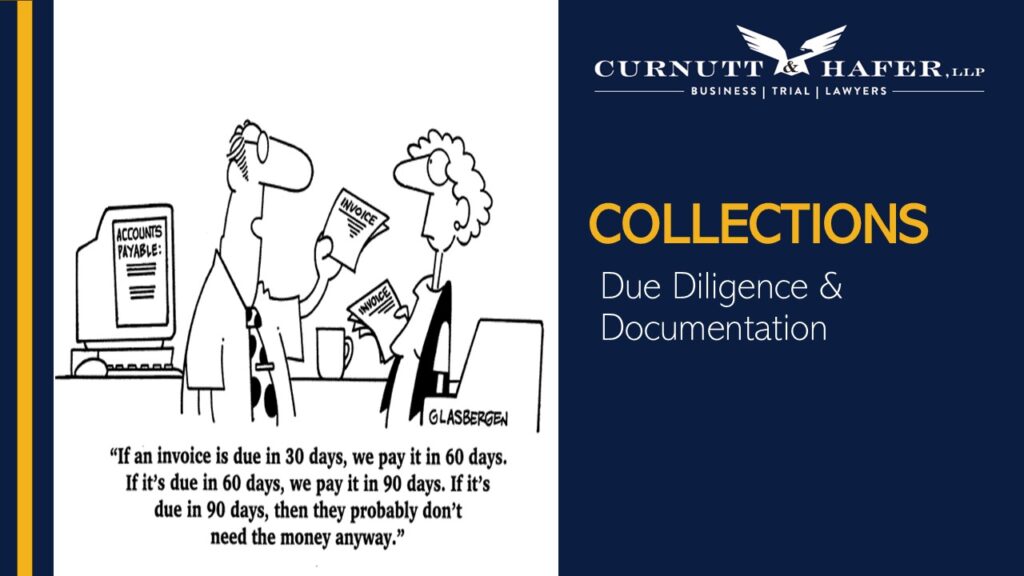
Collecting fees and invoices for services rendered is not always as simple as we’d like. The more time that passes from the time the service is provided, the harder it can be to collect. To avoid misunderstanding and delay, have a written, clear collections policy in place and follow it consistently to avoid having to hire an attorney to collect a stale debt.
In the area of employment, it’s prudent to determine the nature of the employment right from the start. An independent contractor is not an employee, and more likely is hired for a project with a finite time frame and scope. However, if someone is working part-time, but on a regular schedule and you control the details of how they do their duties, chances are they should be categorized as a part-time employee. This is important for a number of reasons, including whether you should be paying payroll taxes on them, or whether they are handling their own tax filing as an independent contractor.
Although Texas is an “at will” state, meaning an employee can be terminated or resign “at will”, there are still things to consider. You aren’t permitted to fire someone for an illegal reason, such as based on their race, gender, or age, as examples. It’s always wise, if an employee isn’t performing up to expectations, to provide feedback and counseling, and write out a performance improvement place so that everyone is clear on expectations. That way, if you do need to part ways, it doesn’t come as a total surprise. With some issues, if you’d just not sure how to proceed or you have a gut feeling that something isn’t right, it’s never a bad idea to consult with an attorney to make sure you’re on track. One hour of counseling or planning with a lawyer you trust may ultimately help you prevent a long and expensive lawsuit down the road.
For more information feel free to contact Kelly at 817-548-1000.
The Supreme Court of Texas held in In re City of Dickinson that the attorney-client privilege is not waived for clients who offer expert testimony in their own case. The Court’s holding emphasized the importance of the attorney-client privilege and its role in the legal system.
The dispute arose when Texas Windstorm Insurance Association, the Defendant, offered an affidavit from its corporate representative that included both factual and expert opinions on the Defendant’s behalf. The Plaintiff, the City of Dickinson, contended that the email communications between the attorney and his client about the client’s expert testimony were discoverable because the City, as the client’s opposing party, was entitled to discover “all documents . . . provided to, reviewed by, or prepared by or for [an] expert in anticipation of a testifying expert’s testimony” under Texas Rule of Civil Procedure 192.3(e)(6). The trial court agreed with the City and ordered Texas Windstorm to produce the emails, which prompted Texas Windstorm to seek mandamus relief.
In making its decision, the Texas Supreme Court focused on whether Texas law required a party to disclose material that would otherwise be considered privileged. The Court looked to Texas Rule of Civil Procedure 194.2 rather than Rule 192.3, because Rule 194.2 discusses the permissible content of requests for disclosure. The Rule states in relevant part that “[a] party may request disclosure of . . . all documents, tangible things, reports, models, or data compilations that have been provided to, reviewed by, or prepared by or for the expert in anticipation of the expert’s testimony” so long as the expert is testifying and “is retained by, employed by, or otherwise subject to the control of the responding party.” The Court held that although a party may be permitted to request such disclosures under Rule 194.2, the Rule does not mandate a party to make such disclosures.
The Court then looked to two other provisions within the Texas Rules of Civil Procedure to confirm that Rule 194.2 does not require disclosure of privileged material. The Court first looked to Rule 194.3 which provides that information under Rule 194.2(f) (expert witness testimony) must be disclosed by a request for disclosure “unless otherwise ordered by the court.” The Court stated that this language indicates the Rules do not require disclosure, but allow the trial court to limit or relieve any parties’ disclosure obligations under Rule 194.2.
The second provision the Court’s opinion discussed was the official comments to Rule 194 which explain that a responding party may assert any privilege to a Rule 194.2 request, with the exception of work product. The commentary states in relevant part that “[a] party may assert any applicable privileges other than work product using the procedures of Rule 193.3 applicable to other written discovery.” The Court concluded that the comment is clear that the Rules do not mandate disclosure of privileged material, and a party may assert such privilege when applicable, as it was in the case before the Court.
The Court cited several instances where Texas courts have overwhelmingly upheld the attorney-client privilege and noted its importance in promoting an attorney’s duty to provide candid legal advice. The Court’s holding confirms that Texas courts will uphold the attorney-client privilege at any instance when the Rules permit it to do so.
[1] In re City of Dickinson, No. 17-0020, 2019 WL 638555 (Tex. 2019).